• Home
  • About
  • Transformation Stories
  • Contact Us
  • Blog
    • Blog
    • Perspectives
  • Home
  • About
  • Transformation Stories
  • Contact Us
  • Blog
    • Blog
    • Perspectives
How can healthcare and health-tech companies be innovative to change behaviours, improve outcomes and reduce costs?
  • March 30 2021|
  • 0 comments |
  • Category : Perspectives

Today healthcare is looked at as a series of discrete events managed by different organisations or service providers. Hospitals are structured in silos, health-tech companies are creating products in pockets, insurance companies are worried about mortality and pharma companies are concerned only about the efficacy and safety of their products. These divisions into silos or innovations in pockets make sense to the hospital or a health-tech company or a pharma company but make no sense to the patient who sees and feels the entire service as one experience.

The concept of innovation in healthcare is often in the form of equipment, devices or medical technique. Recent research shows redesigning processes and practises to improve patient satisfaction can be positively associated with clinically successful outcomes and patient experience. Across the health care industry, companies need to organise their businesses around what the ‘humans’ in their customers need and feel. Healthcare is moving from a focus on physician-reported outcomes and volume-based care to overall well-being and the patient experience.

The value delivered by the product or service should be seen in totality, from learning about it, choosing and buying it, to using it. Service design creates easy, distinctive, and rewarding customer experiences that can unlock value by boosting loyalty, reducing dropouts and migration, and making companies stand out from their competition.

Service design is a user-centric approach that focuses on holistic service experiences. Methods like service blueprints, customer journeys and scenarios investigates the holistic experience and touchpoints. This involves not only designing the functionality, safety and reliability of the product or service, but the whole journey as it is experienced by the users including both tangible and intangible qualities.

Service Experience and Digital Transformation in healthcare and health-tech sectors should be tightly intertwined for better patient health outcomes, overall patient experience and wellbeing. Health-tech companies can’t hope to change their customer experience and generate better outcomes without transforming the way their business functions across the value chain. However, it is important to understand — when applying service design thinking — digital alone isn’t enough. Offline and online channels must be considered at every touchpoint.

The service Design approach combines ‘human-centred’ design, behavioural science and data analytics to identify deep insights that have the power to drive innovation across the healthcare ecosystem. Now more than ever, health-tech solutions need to be innovative that can change behaviours, improve outcomes and reduce costs. The first step in designing a seamless service experience is crafting an experience strategy. The focus then must be on the front-end and back-end processes integration and should be orchestrated to manage the entire healthcare journey.

Digital transformation, change management, and the careful design of touch-points in online and offline channels — all impact the customer/ patient experience. Only when these complex ecosystems are considered in their full context, centred on the humans they are meant to help, will lasting success be created.

(This Perspective was originally published on March 29, 2021 by Shekhar Badve on LinkedIn)


Why we need to look beyond time (time is money) as the only axis for innovation.
  • March 09 2021|
  • 0 comments |
  • Category : Perspectives

Our world is speeding up. Technology is often blamed but a more in-depth examination points to man’s desire and ability to create new economic models which have to lead to the progressive commodification of time. After all, ‘time is money’, or time is the basis for economics and all the supporting technologies. These technologies brought us all the conveniences and comforts that were not imagined a decade back.

But on the contrary, the recent global upheaval made us aware and accept basic human needs and emotions far more deeply than ever before. We have realised what really matters to us and what were the appendages. As an outcome, we have started looking consciously at real human experiences and ways to satisfy the very essence that makes us who we are.

If time (time is money) has been one of the axes; what could be the other axis?

The other axis could be if we combine the exponential speed and power of technology to create new techno-economic models with a deeper understanding of our needs and emotions. This approach can positively affect the societal fabric and philosophy of everyday life. Like the light at the end of the tunnel, this complex situation presents us with a great opportunity to think differently and challenge the status quo.

The new axis can move organisations that traditionally used design for improving the look and functionality of products and create convenience (time-saving) to opportunities that we have never seen before. To make the most of the new axis understanding humans and the entire system of which we are an integral part is critical. We are not the system! The new axis uses deep human insights and rapid prototyping, all targeted at getting beyond the basic assumptions that block effective solutions. This axis is — inherently optimistic, constructive, and experiential — addresses the fundamental needs of the people.

Embracing this approach will help organisations be more innovative, be the best fit for the evolved customer psyche and reduce expensive product failures or changes. This new way, the integrated approach at the core of every organisation, provides a totally new axis for innovation and drives the change that matters the most.

(This Perspective was originally published on March 8, 2021 by Shekhar Badve on LinkedIn)


Why understanding cultural codes is important to understand human behaviour
  • March 01 2021|
  • 0 comments |
  • Category : Perspectives

Ruth Benedict says One of the handicaps of twentieth century is we have the vaguest and most biased notions, of not only what makes Japan the nation of Japanese, but what makes India a nation of Indians, France a nation of Frenchman…

Lacking this knowledge, each country misunderstands the other.

If we “decode” the elements of culture to discover the meanings and emotions, we learn a great deal about human behaviour and why and how it varies across the planet. The cultural codes are hidden within the unconscious of every culture.

Culture code

1: you can’t believe what people say

2: emotion is the energy required to learn anything, the keys to imprinting

3: the structure, not the content, is the message. Eg the connection between driver and the car rather than the car or types of cars

4: imprinting: first 7 yrs of life.

(This Perspective was originally published on February 28, 2018 by Shekhar Badve on LinkedIn)


Why Banks and Insurance Companies Need To Use Service Design Process To Win and Retain Customers
  • February 27 2021|
  • 0 comments |
  • Category : Perspectives

Just imagine the first thing that your insurance company asks you “What’s your customer number?” when you are feeling emotional and vulnerable after an event like a car accident, flooding in your house, or having a wallet stolen in a foreign country. Most often these organisations forget there is a ‘Human inside the Customer’. Yet all processes and systems have been built with this as the starting point of the conversation.

Most people dread calling their insurance company to make a claim. The expectation is that it will be a negative, complicated, time-consuming process, and at worst, they would disagree to settle the claim because of something in the small print that you forgot to read or couldn’t understand, banks are no different.

As bankers, you need to realise that being indifferent or oblivious to rising customer expectations, demands for seamless overall experience through your touch points, competition from emerging fin-tech companies, digital and technological advancements has the risks that run very high. In today’s world, banking is no longer about just money but is about the overall banking experience. Do check, are our customers with you because they love your brand or they have no choice or they are just plain habitual.

Bain & Company’s recent survey of the customers of 362 companies shows only 8% of them described their experience as “superior”. The need is urgent: customers’ have great many choices today than ever before, and more touch-points through which to pursue them. In such an environment, simple, integrated solutions to problems — not fragmented, complicated ones — will win the loyalty of the fickle minded time-pressed customer.

Service Design is the method or the approach, that will help you solve such complex challenges. It helps you see the entire customer journey and engagement model from 35,000 ft, it reduces complexity and then helps you rethink the whole customer-organisation engagement approach. What value and experience does your organisation offer at various touch points and what is expected. Where are the dropouts, what is causing leakage and what leads to dissatisfaction.

Service Design Blue Print and Tools will help you rewrite explicit and implicit value that gets exchanged between your bank or insurance company and your customers (Humans) throughout the journey. Service Design will enable you to better predict and respond to change, innovate to differentiate your brand and create memorable experiences for your customers.

To win over these challenges and achieve success, companies would need to know more than buying habits, incomes, and other characteristics used to classify their customers’, they need to know more about the psyche, thoughts and emotions that customers’ interactions with products, services, and brands induce. More the companies know about these subjective experiential factors and the role every touch point plays in shaping them, more the chances are that, memorable customer experiences and deeper satisfaction will be a reality.

(This Perspective was originally published on February 26, 2018 by Shekhar Badve on LinkedIn)


Why don’t we hear a warning bell whenever we are about to make a serious error?
  • February 25 2021|
  • 0 comments |
  • Category : Perspectives

Muller-Lyer illusion is when you see lines with arrows pointing in different directions, and most often make a mistake of judging which one is longer. Caution is you should not trust your impressions of length.

Unfortunately, this sensible procedure is least likely to be applied when it is needed the most. We would all like to have a warning bell that rings loudly whenever we are about to make a serious error, but no such bell is available, and cognitive illusions are generally more difficult to recognise than perception illusions.

How can service design process take this aspect into account to avoid errors or mistakes.

The voice of reason may be much fainter then the loud and clear voice of intuition. More doubt and confusion is the last thing you want when you are in trouble. The upshot is that it is much easier to identify a minefield when you observe others wandering into it when you are about to do so. Observers are less cognitively busy and more open to information than actors.

We can minimise errors arising out of our intuition, memory and biases by reducing cognitive loads of people in the selection and decision making process. Aiding people in making right choices goes a long way for services and products brands.

There are 8 types of biases that can help you while analysing or evaluating a service design challenge.

1 Survivorship bias: Paying too much attention to successes, while glossing over failures

2 Confirmation bias: Placing more value on information that supports our existing beliefs

3 The IKEA effect: Placing too much value on the things we’ve done ourselves, often while discounting other people’s smart ideas

4 Anchoring bias: Being overly influenced by the first piece of information we receive

5 Overconfidence bias: Thinking your contribution is more important than it is

6 Planning galaxy: Underestimating the time it will take us to finish a task

7 Availability heuristic: Placing more value on the first idea that comes into your head

8 Progress bias: Overstating positive actions while downplaying negative ones

(This Perspective was originally published on February 24, 2018 by Shekhar Badve on LinkedIn)


What design should be thinking
  • October 12 2020|
  • 0 comments |
  • Category : Blog

We are living at one of the greatest inflection points in the history of human civilisation. The inescapable forces of Entropy are necessitating a reset in nearly all walks of life. 

And therein we have a choice to make between thinking incrementally to soothe our immediate anxieties, and radically imagining a whole new paradigm of life in harmony with our planet and its inhabitants.

At Lokusdesign, we strongly believe in the power of the latter to bring extraordinary transformation to life and its systems in a manner that raises human consciousness and ushers in a new golden age for humanity.

Download our e-booklet to know more!

Download

Entropy @source
  • September 03 2020|
  • 0 comments |
  • Category : Blog

We are living at one of the greatest inflection points in the history of human civilisation. The inescapable forces of Entropy- the ever increasing chaos, disturbance, and disorder that we are consumed by- are necessitating a reset in nearly all walks of life.

Where does this Entropy come from?

What gives rise to it?

What lies at the source of it?

This e-booklet is an attempt to discover the answers to these questions within the profound wisdom and musings of some of the world’s greatest thinkers.

Download now!

Download

Design & Dissonance
  • September 02 2020|
  • 0 comments |
  • Category : Blog
  • Why is it so hard for us to let go of our beliefs or behaviours? 
  • Why is it so hard for us to accept divergent perspectives; or adopt beliefs or behaviours contrary to the preexisting ones?

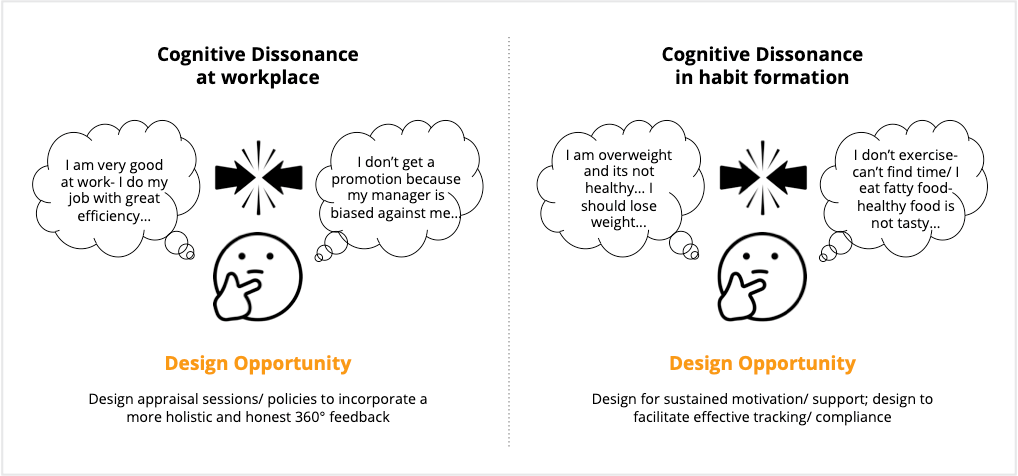
A lot of it has to do with the way our brain deals with the experience of cognitive dissonance.

When we hold two or more conflicting beliefs or attitudes or ideas (“cognitions”); or act or behave against either of these, we experience “cognitive dissonance”. It is what we experience when we lie in spite of believing that we shouldn’t; or when we smoke while knowing that it is injurious to health; or when we cheat while we are on diet; or when we confront a discordant point of view on social media.

Far from being pleasant, the experience is characterised by mental stress and uncomfortable feelings. Stress levels are especially higher when our cognitions/ behaviour go against our self-concept.

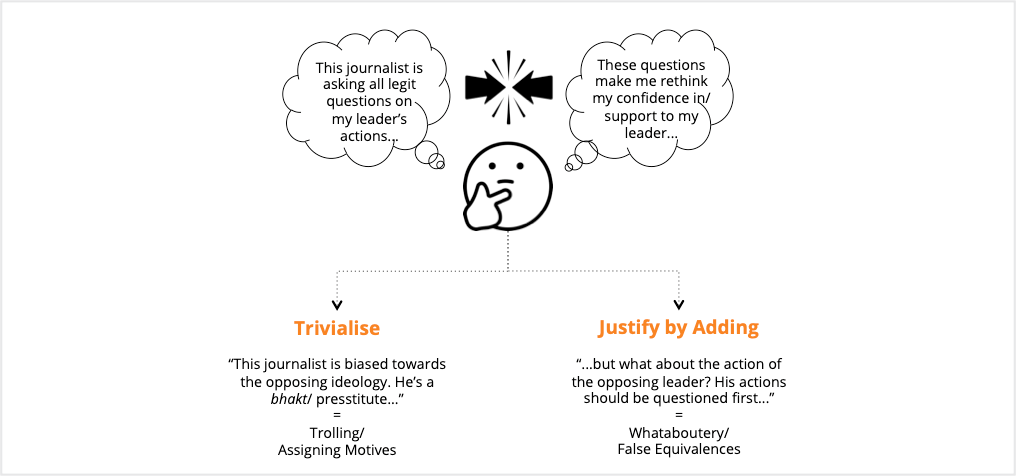
Processing dissonant cognitions thoroughly, and thereby affecting a change to our beliefs or values or behaviour requires the brain to expend a lot of energy. Our brain, however, has evolved to conserve energy: a well-learnt survival strategy. And so, it typically employs either of the following more energy-efficient tactics to reduce dissonance as quickly as possible:

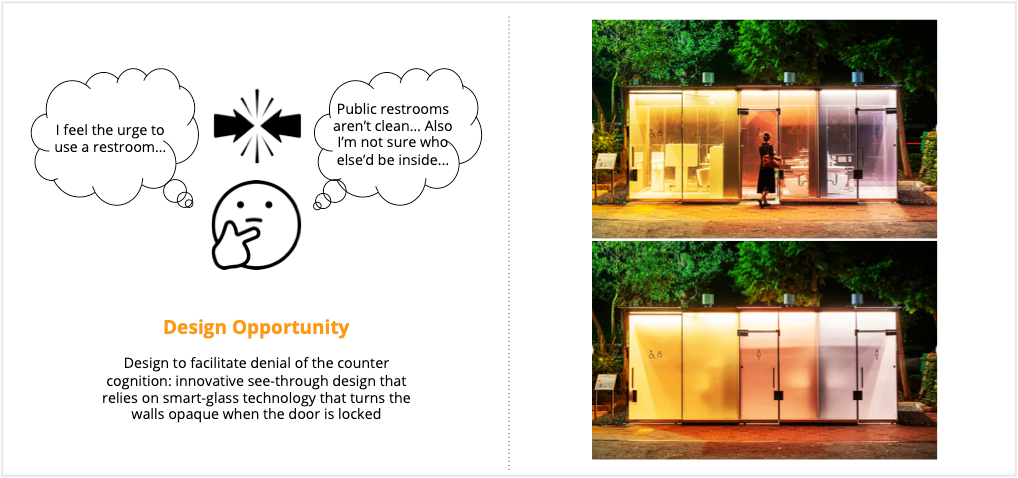
  • denial/ ignorance of the counter cognition/ behaviour
  • trivialisation of the counter cognition/ behaviour
  • justification of the previously held cognition/ behaviour by modifying the counter cognition/ behaviour
  • justification of the previously held cognition/ behaviour by adding new consonant cognitions/ behaviours

Having said that, a change of beliefs or behaviour in line with counter cognition is also possible- but it needs the counter cognition to be powerful enough to overcome the brain’s attempts at denial, trivialisation, or justification. It explains why it is hard for us to let go of our beliefs or behaviours; or adopt beliefs or behaviours contrary to the preexisting ones. It explains why we more likely tend to indulge in whataboutery, trolling, and assigning motives when confronted with accusations or uncomforting questions instead of rationalising or reflecting over them.

It also explains why the more radical, paradigm shifting ideas often get ignored, mocked, and repudiated for long before gaining wider acceptance: why Copernican Heliocentrism was condemned as heretical for centuries after it was first proposed; or why racial/ caste justice and marriage equality still remain a distant dream for large populations globally.

Our brain’s preferred/ default way of dealing with cognitive dissonance is thus a big impediment to our learning new behaviours, appreciating diverse ideas, and bettering our way of life. It pushes us deeper down the abyss of our echo chambers, making our behaviour increasingly vulnerable to manipulation- as partners, citizens, consumers, and voters. And with highly sophisticated AI powering predictive analytics and further hyper targeting of individuals in the future, one can only imagine the damage this can do to us as individuals and societies!

But here’s the good part- awareness of cognitive dissonance and understanding how our brain deals with it can also be leveraged in design to positively alter life experience. It can help us design frictionless, delightful customer journeys by identifying and designing for specific high anxiety milestones: both pre- and post- purchase. It can help us create seamless brand experiences by devising brand- positive affirmations across key touchpoints.

It can help us design great employee experiences by identifying and designing for specific high anxiety processes: from induction to appraisal to separation. It can help us facilitate more productive brainstorming sessions and meetings; and better appreciate genuine constructive feedback from others. Even at a personal level, it can help us stay the course in keeping with our new year’s resolutions; and cope with addiction, anxiety, and depression better.

Applications of it could extend to the social domain as well. Tokyo’s latest attraction- the transparent public restrooms installed by Shigeru Ban Architects in its Shibuya district- are a great example of this. These restrooms, through their counter-intuitive design strike directly at the dark, dirty, smelly and scary stereotype of public toilets in people’s minds; and encourage them to access these without feeling uncomfortable.

On similar lines, we could also design to encourage more people to wear masks and maintain social distancing during a pandemic; or to adhere to traffic safety rules while driving. We could design policies to get more people to pay their taxes; or to get more people to transition to a cleaner, greener, more sustainable lifestyle.

The possibilities are endless and for all to pursue!

(This piece was written by Sanket Shah. In his role as a Strategist at Lokusdesign, he works at the crossroads of Design Thinking & Brand Strategy to create valuable brands in the midst of complexity of business environment.)


Resilience
  • May 28 2020|
  • 0 comments |
  • Category : Blog

If you look carefully, you’ll find examples of resilience all around- from nature to sciences, to philosophy, to legends…!

Our e-booklet is intended to highlight just a few. We sincerely hope that within these, you too will find inspiration for enhancing the resilience of systems, brands, spaces, and experiences around you.

Download now!

Download

Navigating the Customer Experience conundrum – Here’s what should matter
  • September 19 2019|
  • 0 comments |
  • Category : Perspectives

Related image

While evolution is still (somehow) a divisive topic, what it has taught us is this – only the fittest shall survive. In the branding context, the adage ‘survival of the fittest’ shows that only those best equipped to bear down the fluctuations and challenges of shifting environments will be successful.

The good news is that unlike biological and human evolution, business evolution does not have to rely on lucky mutations. We can enable evolution leveraging technology – our secret (or rather, not so secret) weapon.

Then and now – the evolution of customer expectations

When we are talking about evolution how can we not talk about how customer relationships have evolved. We have come a long way from the time when the terms of customer relationships were dictated by the brands. It was all about pushing – push your fliers, emails, phone calls, voice mails, mailers, newsletters to the customer. The brand decided ‘hey, this is what I want the customer to know and hence I shall provide only this information’. But what did the customer want? This didn’t quite matter to most brands.

Today the story has flipped. The customer is front and center. The customer is in charge of how they want to interact with the brands, what they should talk about, and which channel is their preferred one. Everything must be personalized and contextualized and all these interactions have to take place at the right place, at the right moment and on a device of their choice. Seamless and cohesive with individualized touchpoints is the new mantra.

With digitization driving continuous disruption, it’s abundantly clear that customers want more than superior product features or functions. What they want more is great “service” –personalized, immediate, and convenient.

On the one hand. all this seems easy to provide owing to the plethora of technologies at our disposal. Yet, brands are failing to provide the elevated experience that the customer wants.

Customer Experience – What Customers Want

This could be attributed to the fact that even now brands are failing to recognize that the lines dividing products, services, and environments are continuously fading. Instead of focusing on creating only a stellar product, conscious design now needs to integrate all these elements and then identify the right combinations to create compelling customer experiences.

Take Tesla for example. They have a great product but how did they transform their customer experience? By simply opening their futuristic showrooms in malls and prime locations and designing an environment that helps the customer connect with their product.

What is evidently clear is that customer experience strategies can no longer be created in isolation. Your customer experience design can no longer just be dictated by the 4 Ps of marketing…because today, your competition is not just the organizations belonging to your industry. Your competition is everybody.

That is to say that my expectation as a customer from an airline will perhaps be the same as my expectation from Zappos. And while this might not seem like a fair comparison, it is how the playing field is today. The best way to identify how to deliver a great customer experience is to know what they ‘value’.

United Airlines did a great job of completely flipping their customer experience on its head when they were developing their Business Class product. Their initial focus was on designing a luxury experience. However, upon talking to their clients they discovered that luxury was not just the bells and whistles. Their customers were more interested in being rested and well-slept upon arrival. Rest trumped luxury and this led the airline to completely redesign their customer experience, including the pre-departure shenanigans. This change of strategy (among other things) helped United Airlines climb out of bankruptcy

Customer Experience does not come in a ‘one size fits all’ package

It is clear that customer experience too, much like everything else, does not come in a ‘one size fits all’ package.

You can have the most up-to-date technology in place, have the right product at the right price, and yet your customer experience could be poor. You could be doing everything that your competition or the market place is doing and still your customer experience might not work. This is so because customer experience is not just about touchpoints and journeys. It is about interactions and experiences with your product and service.

It makes sense for customer experience strategies to leverage the usual suspects (read, data, technology, etc.). But the strategy in itself has to emerge from understanding ‘who’ you are and what that represents to the customer. What naturally emerges from that understanding is ‘what’ the customer wants from you and ‘how’ do they want to engage with you. That drives an understanding of what they are trying to achieve by using your product or service. It helps identify the behaviors (both natural and constructed) that are connected to the buying experience. And it comes from constant introspection of the core of your brand and continuous assessment of how the customers relate to the product and the experience you are providing.

Technology has to complement the human element and not overshadow or replace it. Because today people don’t just buy a product. They buy into what the brand represents, the idea and the experience. And they expect this experience to be unique, original, and authentic.


Write to us on info@lokusdesign.com.


‹ Prev123456Next ›Last »
© 2018 Lokus Design Pvt. Ltd. All Rights Reserved.