• Home
  • About
  • Transformation Stories
  • Contact Us
  • Blog
    • Blog
    • Perspectives
  • Home
  • About
  • Transformation Stories
  • Contact Us
  • Blog
    • Blog
    • Perspectives
What can we understand from a Himalayan Musk Deer who ends up plunging to death by jumping off the high cliffs?
  • May 21 2021|
  • 0 comments |
  • Category : Perspectives

As circumstances change, the challenges we face vary in severity, proportion and impact. But haven’t humans always transcended their limitations! We always aspire to improve and become better. Sometimes, however, we get too caught up in the pathways already paved. Just like the army ants, who keep following each other in a continuous loop when they lose their pheromone track (only to die of exhaustion!), we circle the endless loop of set paradigms.

Although invisible, a magnetic field is a force that pulls on ferromagnetic materials and attracts or repels other magnets. And it emerges out of the internal composition of magnets. Likewise, our behaviour and actions too emerge out of who we are from within, what we value inherently. Every day, we invest our energy in trying to align ourselves to our surroundings. But in doing so, we lose self-congruence. When our behaviour and actions do not align with our core values, we lose harmony. And such an increase in our internal disturbance is just like the Entropy inside a magnet that reduces its magnetism.

It is just like the entropy that consumes the Himalayan Musk Deer. Excited by the ravishing odour of Musk, the Deer frisks about anxiously sniffing under trees, and searching everywhere to find the source of the fragrance. Unable to find the source, he grows very restless and angry. And in this frenzy, he ends up plunging to death by jumping off the high Himalayan cliffs. If only the Deer could touch his nostrils to his own navel, he would have found the cherished Musk and saved himself from his painful death!

Our Positive Valence is our core building block that is intrinsic, inherent, authentic and positively inspiring to us. It is the essence, the fundamental quality that the world would miss in our absence. It is that which enables the magnetic field for a magnet. It is that which delivers musk to the Himalayan Deer.

But we people have been hard-wired to set our reference points outside of us, even when we are deciding for ourselves. All our external reference points- be it our families, friends, professional colleagues, or even the larger socio-cultural context- are fickle variables beyond our control.

This lack of self-congruence is where our deepest insecurities stem from. It is the principal source of the internal Entropy that we are perpetually consumed by. And there is external Entropy as well- the way external forces of heat and damage hamper a magnet’s potential of creating a strong magnetic field, our potential is hampered by the many self-consuming and powerful influences surrounding us. We have to distance ourselves from this Entropy to discover our Positive Valence and maximise its potential towards creating enduring relationships and inspiring positive action.

(This Perspective was originally published on May 20, 2021 by Shekhar Badve on LinkedIn)


What creates chaos, disturbance, or disorder? How do we reduce this?
  • May 20 2021|
  • 0 comments |
  • Category : Perspectives

The intention of this article is to present questions that would provoke every policy or decision-maker or an inventor or a designer, or every thinking person. These are my points of view, those could be used to explore to improve situations governing our cities, planet, our societies, our environment, and our ambiguous future. As most of our methods and systems have failed or at times create more challenges than the ones we already have I feel these approaches would be thought starters to understand and find solutions in a non-typical way.

Let’s start with some basics of what is entropy and how can we use this knowledge to create change. Entropy has been associated with chaos, disorder, or disturbance, but it is much more than only chaos or disturbance (another topic for another time). The reason a deck of cards doesn’t reorganise itself when you drop it is because it’s naturally easier for it to remain unordered. Think about the energy that it takes to arrange cards by value and suit (scale it to our cities, society, and the planet, and one understands the gravity of our situation). It takes a lot of energy to reduce entropy or maintain equilibrium. A simple example to describe entropy is that it makes a hot cup of tea go cold, but unfortunately, there is no freeway to getting this lost heat (energy) back and reuse it. Energy is transferred from the hot cup to the surrounding air, the table on which the cup is kept and to your hands, in this process the energy of the hot cup is lost to the surrounding system, thus increasing the entropy of the surrounding system.

Energy is the ability to do work (or to cause change). Energy plays a crucial role in ordering and maintaining complex systems. Energy plays an essential role in cultural systems such as a city’s inward flow of food and resources amidst its outward flow of products and wastes; energy is a key ingredient in today’s economy, technology, and civilisation.

Technological advancement is a prime feature of cultural evolution occurring on Earth today. Technology decreases entropy locally by artificially manufacturing complex products, at the cost of expending energy and increased entropy in the larger environment of raw materials used to make those goods. Throughout the past few centuries, people chose shorter travel times, lower transportation costs, and heavier shipping loads; steam-powered iron ships replaced wind-powered boats, while jumbo jets have superseded them all. Likewise, horses and mules were eliminated by steam and eventually by gasoline engines. Typewriters, slide rules, air-conditioners, refrigerators, and computers among many other innovative inventions, were selected under the pressure of customer demand and commercial profit, often replaced initially by luxuries that eventually became necessities.

Either way, energy remains the driver, and with accelerated pace — a clear trend shows that engineering improvement and customer selection over generations of products made machines more intricate and efficient, yet more complex. The bottom line is that more energy is expended to drive those newer improvements. However, all of this progress, which has decidedly bettered the quality of human life as measured by health, education, and welfare, inevitably came — and continues to come — at the expense of greatly increased demand for more energy — to what end we cannot be certain. It is a vicious circle!

Two aspects to keep in mind one, energy is always conserved but it is transferred and the second, in any process entropy always increases. To reduce entropy we need to expend energy, that too continuously, so the question is, do we have an unlimited supply of energy and the answer, of course, is no. It takes very little intelligence to understand why we need to conserve energy and reduce complexity. Let me broaden the meaning of energy; it is not only the electrical or the mechanical or thermal or potential energy but energy available in the form of human effort, time, or money.

So how do we reduce complexity and entropy? Can the new advancements be designed with complexity and entropy reduction as their primary criteria? What should design be looking at as a guiding light? Shouldn’t we move away from form follows function to purpose and harmony? Shouldn’t systems design be our priority? Are our priorities set right? So what are the sources of low entropy from where we can draw energy? Can they be planted in our existing systems? How can we tap into free sources of low entropies? What’s making our entropies increase? How can we barter the currency of low entropy for carrying out our life? What would be our future currency? What would stock markets trade? Could there be readily available complexity and entropy metrics, before any planning or design exercise starts! Can’t we slow down, at least in some aspects of life?

Shouldn’t we be applying our limited energies to things that result in the betterment of society, or humanity, or the planet? Let’s think, at least!

(This Perspective was originally published on May 19, 2021 by Shekhar Badve on LinkedIn)


The Covid pandemic has shattered our international claim to fame, the Jugaad model.
  • May 14 2021|
  • 0 comments |
  • Category : Perspectives

It is high time we understand micro and macro entropies, rethink and reimagine.

I was amazed to see many CEOs going bonkers over the Jugaad model, citing India’s way of innovating and quick fixing everything. Some have written best-sellers. As many praised Jugaad as India’s contribution to innovation and frugal engineering, we took it as an endorsement and much-deserved world recognition, something original from India. The reality is, India has romanticised a totally wrong and devastating casual fix-it-all approach and use it anywhere attitude instead of a far systematic planning and problem-solving method. Unfortunately, we take pride in Jugaad and glorify the person who got things by doing Jugaad.

Jugaad at best can be a very small step in a larger innovation or problem-solving process. It can be a shortcut, that too not always, to get out of a sticky situation but we have taken it to the next level; it has become our nations’ standard operating procedure. Government to bureaucrats, to policymakers, to every decision-maker to every citizen of our country swears by Jugaad. Jugaad has totally infested our nation, made us hollow from inside.

The Covid pandemic has shattered our glorification. Several Indians have not died purely because of Covid but they died of our Jugaad attitude. “Dekha jayega jab hoga tab” why fix it if it’s not broken method of planning and total lack of foresight of our political leadership and bureaucracy could not provide patients with oxygen supply, ICU beds, life-saving ventilators, and crucial medicines. The sad stories of people begging for oxygen are innumerable and heartbreaking. These stories will be a permanent reminder to us about our systems’ unpardonable failures. See how well we have managed the crisis become cases studies and we celebrate them. This is where it all begins. We have paid a price for this Jugaadu attitude and our rubbish planning.

‘Jugaad’ is a curse and a hindrance, it forces us away from planning anything systematically and reaching excellence. Jugaad is about, imperfection is OK as long as the job is done. Jugaad is an attitude, that will neither make us self-reliant nor allow us to be good at anything. Jugaad cannot be celebrated!

What’s the point of celebrating how well we have managed to come out of the crisis if in the first place the crisis could have been totally avoided. If India in March 2020 went through the most severe lockdown ever, what led to this level of stupid complacency in January 2021. It was evident and seen across the world that we would be hit by a big and an even deadlier second wave. World statistics were showing a disaster in the waiting. It doesn’t take much intelligence to plan and organise ourselves well in advance.

Why crucial medications were not produced in bulk and kept ready? Why weren’t oxygen plants ready and a Mumbai model planned well in advance? Why were jumbo Covid centres dismantled? Why didn’t we place orders with other foreign vaccine manufacturers? Why were vaccination camps not organised at mass levels after the first wave? Why were private sector hospitals not engaged from the very beginning as part of vaccine distribution? Why were super spreader events allowed? Why does the Supreme Court have to intervene in every possible critical issue in this country? The list of severe lack of systems planning and forecasting issues is endless.

Jugaad hasn’t worked it is in fact destroying us: India is gasping for breath, people helplessly are on the streets looking for medicines and queuing up outside hospitals for ICU beds while patients die waiting for one. India needs to re-think the whole game from a systems design perspective by understanding entropies in almost every aspect of public interest: health, security, delivery of public services, and natural disasters. We cannot plan to avoid and handle emergencies with Jugaad and ad hoc decision-making.

Our post-pandemic government/s will need a totally new avatar at two levels: One at systems planning and design level; envisioning, understanding micro and macro entropies, forecasting, planning, and designing systems for implementation. Secondly, a government that is performance-driven, agile, and quick at decision making. The world has changed around us and all the fatal flaws are exposed this is the time to rethink and redesign.

Let’s think and change!

(This Perspective was originally published on May 12, 2021 by Shekhar Badve on LinkedIn)


How to survive in today’s spiraling religious polarisation?
  • May 06 2021|
  • 0 comments |
  • Category : Perspectives

“Religion is the opium of the world” ~ Karl Marx

Religious fanaticism is a mega scheme that produces pointless work. As a result, it wastes energy, time, money and generates material destruction, mental agony, and depreciates human life, these are all variations of Entropy. This phenomenon has existed throughout the centuries and continues to grow in one form or another. J.K. Rowling had said it wonderfully “The trouble is, humans do have a knack of choosing precisely those things that are worst for them.”

There is a revived effort of brainwashing by the clergy around the world to attract and convert more faithful with all kinds of dogmatic beliefs and rewards. The value of human life is thus reduced by this promise of sanctitude. For the major part of human history, religion and economics have been the two most powerful stories which almost all of us believed and have stood for. We have fought numerous wars and killed millions to behold these fictitious ideas. Masses are drawn to such hysteria under the need for association or a strong fear of losing out. Buddhism, Jainism, and a few more religions are an exception to such a craze.

Entropy is the energy wasted when any work is performed. Entropy is also defined as the level of disturbance or destruction which irreversibly reduces the quality of the environment and leads to a chaotic situation. Entropy is seen in an ecosystem, the biological world of a living organism, even the politics, and religions in a societal system. Entropy is based on a stochastic model with uncertain outcomes, which aptly describes the complexity of our world today.

Is there a possible cure for the problem? Should we be afraid of entropy? Should we hope that a supernatural deity will save our world? Is there an alternate approach?

Amongst other possibilities, one possibility in an era of turbulence and uncertainty is interfaith action that may offer an important antidote to our precarious situation. Conscious spread of values of empathy, compassion, forgiveness, and altruism are needed today more than ever.

Another approach is to create a parallel story alongside religion and economics to make people and nations understand the priority and importance of harmony. We need to create and propagate an equal or more powerful story of harmony if we are looking forward to overcoming these challenges and have a better tomorrow. To conserve energy, and achieve both short-term and long-term benefits we need to start looking at every policy, decision, tool, framework, and method, including design and technologies from the lens of harmony.

In today’s spiraling polarisation not only towards religious sentiments but overt capitalism, if we are to survive and thrive, harmony should be the focal point of every aspect of our society.

Reduction in entropy and utilising our energies for harmony is the hope for our survival and betterment.

(This Perspective was originally published on May 5, 2021 by Shekhar Badve on LinkedIn)


Are we myopically focused on the “user,” in a world of complex systems and services?
  • May 05 2021|
  • 0 comments |
  • Category : Perspectives

Today the world is a complex web of various systems interacting with each other in an interdependent network. Simple to the most complex, everything is a system; education, town planning, traffic management, waste management, healthcare, travel, e-commerce, food, manufacturing, all our services, etc. just to name a few.

The economy and society are experiencing a tectonic shift from products to services. It is evident that this also brings a shift in business and industry characterised by a movement from traditional goods-centered logic to emerging service-centered logic. Leaders and professionals in almost every field are increasingly required to solve complex service-centered problems, there is a great need for understanding the system, stakeholders, and their interlinking. Traditionally in a user-centered design approach, you listen to users, to understand their needs, wants, complaints and critiques. Yes, listening to customers is always wise, but acceding to their requests can lead to overly complex designs or you missing the point (purpose) totally.

“Systems thinking has a certain simplicity and elegance to it — basically, a shift from seeing the world as a machine to understanding it as a network.” — Fritjof Capra

To deal with this fundamental transformation in the world that is taking place, we need to shift from problem-solving (designing products) towards system thinking (designing services). In addition, the very nature of products has also changed. From being purely physical and tangible entities, they are becoming mixed entities, with both physical and virtual attributes. Also, from being individual objects that stand alone, products now are part of complex systems, becoming the touchpoints of a service.

Service design is a way of seeing service, not only from the customer’s perspective, but all the way through the entire service delivery. Service design takes into account not only the customers’ perspective but understands deeply the staff, leadership, available infrastructure, technology to be deployed, communication methods and tools, and the culture of that organisation. The whole service is defined by its purpose.

Six service design principles:

  1. Human-centred: Consider the experience of all the people affected by the service.
  2. Collaborative: Stakeholders of various backgrounds and functions should be actively engaged in the service design process.
  3. Iterative: Service design is an exploratory, adaptive, and experimental approach, iterating toward implementation.
  4. Sequential: The service should be visualised and orchestrated as a sequence of interrelated actions.
  5. Real: Needs should be researched in reality, ideas prototyped in reality, and intangible values evidenced as physical or digital reality.
  6. Holistic: Services should sustainably address the needs of all stakeholders throughout the entire service and across the business.

A successful service design is when the service is user-friendly and relevant to the users while being sustainable and competitive for the service provider. To achieve this, service design engages various disciplines like design, technology, ethnography, economics, psychology to business management to data sciences. Any service must be understood end to end, creating an outside-in view of the organisation as a system and not looking at solving micro problems only. The purpose of systems thinking in a service design project is not only to solve problems but also to create desirable outcomes for all the stakeholders.

  • Global Food Systems Map: https://www.cerealsgrains.org/publications/cfw/2019/jan-feb/Pages/CFW-64-1-0010.aspx
  • Six service design principles are from the book ~This Is Service Design Doing: Applying Service Design Thinking in the Real World, by Adam Lawrence, Jakob Schneider, Marc Stickdorn, and Markus Edgar Hormess.

(This Perspective was originally published on May 4, 2021 by Shekhar Badve on LinkedIn)


Are you angry? In fact, do you remember the last time when you were not angry?
  • April 30 2021|
  • 0 comments |
  • Category : Perspectives

Is cynicism in our national DNA?

Are you angry? In fact, do you remember when you were last, not angry? Doesn’t it seem like everywhere you look there is evidence of the very things that outrage you? The news is full of shouting heads and social media has so many people sharing many things that confirm all your worst suspicions –whatever those may be.

I have observed in recent few years that there is an overwhelming hatred for almost everything possible under the sun. We hate our governments, politicians, decision-makers, leaders (of course there are strong reasons to do so), our national and local policies, healthcare system, our doctors, our education system, traffic management system, infrastructure, waste management systems, our cities, other states, our family members, our neighbours and their success, waiting in queues, all our habits as Indians, and unfortunately these days we hate being Indian too. This list is endless in fact google shows 15,60,00,000 results for what Indians hate. At times I feel cynicism is in our national DNA.

Hatred is the deep psychological response to feeling trapped or being unable to understand a certain sociological phenomenon. Hate, whether turned inward or out, creates a destructive state of mind that wreaks havoc with your physical health and emotional well-being. Hate is part of larger entropy; larger chaos and disturbance. We need to expend energy to control or reduce entropy, but currently, we are running really low on energy. We need to conserve and channelise. For these challenging times and a better tomorrow what we need is more compassion, empathy, positivity, problem-solving, innovation, and holistic thinking.

One predominant global paradigm for measuring national progress, the Gross Domestic Product (GDP), has resulted in an over-emphasis on production and consumption that in turn, is exhausting the planet’s capacity to sustain life. There is an urgent need for a new paradigm of development that can propel human society in a more meaningful, sustainable direction.

Is there something we can learn from our humble neighbours, Bhutan, and about their Gross National Happiness Index?

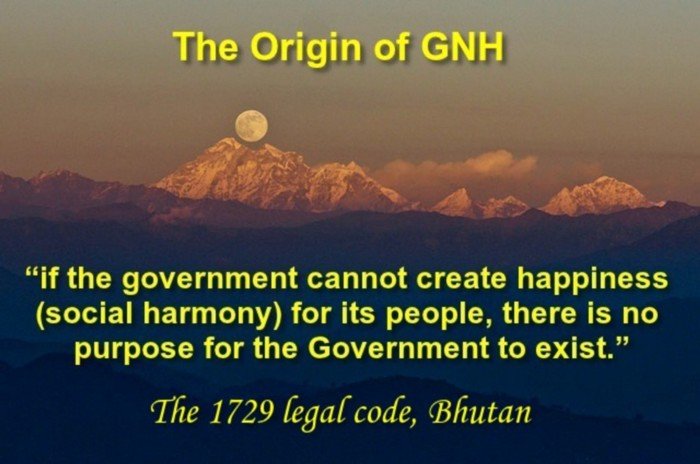
The phrase ‘gross national happiness’ was first coined by the 4th King of Bhutan, King Jigme Singye Wangchuck, in 1972 when he declared, “Gross National Happiness is more important than Gross Domestic Product.” The concept implies that sustainable development should take a holistic approach towards notions of progress and give equal importance to non-economic aspects of wellbeing.

The idea of Gross National Happiness (GNH) has influenced Bhutan’s economic and social policy. Bhutan created a measurement tool that would be useful for policymaking and create policy incentives for the government, NGOs, and businesses of Bhutan to increase GNH. The GNH Index includes both traditional areas of socio-economic concern such as living standards, health, and education and less traditional aspects of culture and psychological wellbeing. The GNH index supports policy-making and acts as a tool to review the potential effects of proposed policies on GNH. The stated goal is that all government projects and policies work together to maximise GNH.

Buddhist understandings of happiness, are much broader than those that are referred to as ‘happiness’ in Western cultures and literature.

The GNH Index includes nine domains

  1. Psychological wellbeing
  2. Health
  3. Education
  4. Time use
  5. Cultural diversity and resilience
  6. Good governance
  7. Community vitality
  8. Ecological diversity and resilience
  9. Living standards

In 2011, the UN unanimously adopted a General Assembly resolution, introduced by Bhutan with support from 68 member states, calling for a “holistic approach to development” aimed at promoting sustainable happiness and wellbeing. This was followed in April 2012 by a UN High-Level Meeting on “Happiness and Wellbeing: Defining a New Economic Paradigm” designed to bring world leaders, experts, and civil society and spiritual leaders together to develop a new economic paradigm based on sustainability and wellbeing.

In a sea of negativity — Bhutan’s GNH is a ray of hope. It is time for us to disperse all the doom and gloom with positivity and action. It’s time to get out of the zone of hatred.

Let’s channelise our hate into an energy, a force for creating change and the change that matters the most.

(This Perspective was originally published on April 30, 2021 by Shekhar Badve on LinkedIn)


Why functional tinkering of an office chair or the office building will not help eliminate workplace stress and solve traffic problems?
  • April 27 2021|
  • 0 comments |
  • Category : Perspectives

Everything that we use, whether it be a piece of medical equipment, the hospital as a system, lights, stationery products, office building, piece of furniture, software interface, food delivery service, book cover, tool, or anything else, there is a function, a task the item is expected to perform and perform well.

Any new functional design of an office chair will improve it to make the users sit comfortably for more than what they already do or make changes to the way the chair operates or is made, etc. or a new design of an air conditioner will make it work better in an even harsher climate, and even better intuitive user interface or better aesthetics of the front grill. These approaches miss understanding the larger purpose. Why do we need an office chair, why are we sitting so long, why are we sitting in a particular way, what’s the most natural way to sit, why do we need to sit to do a particular activity, etc. or why do we need an AC in the first place, without resolving these questions and moving forward is like a domino effect, unfortunately towards collapse.

Esther Derby said when we are blind to systems causes of problems, all solutions we try will likely make matters worse.

We tend to forget what’s the larger purpose, the reason for work or why do we work, why do we need to work in a particular way, what’s the most natural and harmonious way to work can there be an alternate? Our body is not designed to sit for so many hours, creating many physiological problems and eventual degradation. 1 out 5 people globally is a victim of workplace stress, the annual global cost of workplace stress is est. $2.5 trillion. Traffic jams cost $87 billion in productivity in the US and $14 billion per year in New Delhi. Can we look at the entire system and design the work itself instead of functionally tinkering with the chair or the office interiors or the building any further.

Just look around there are so many things we are tinkering with and not thinking about the purpose. Just imagine if hospitals were not only meant to be functionally good but they were to ensure patients emotional wellbeing and harmony if healthcare planning was meant to reduce the need for hospitals or reduce diseases themselves if traffic management systems were not only meant to monitor and control traffic but were to positively change behaviour if governments were not only to ‘so-called manage’ the topical situations but were to look at challenges holistically and plan for the long term if technologies were not only meant to commoditise time but were to achieve harmony for everyone. A simple way to kick start a systemic design innovation cycle is to ask more why questions than what and how questions.

How getting rid of dustbins helped Taiwan clean up its cities is a global case study and a classic example of shifting from functionality to purpose. Rather than functionally tinkering or adding more dustbins they totally eliminated dust bins. Having fewer bins around and waiting for the trash trucks forced them to consider their waste. You can’t just put the trash into a bin and forget but forces you to think about your waste, you will change your purchasing habits, you’ll end up not buying things that you can’t recycle. This kind of systemic change gives them a chance to think about how much trash they generated because they had to hold on to their waste until they see a bin, or when they get home. The question people ask is, how we should be disposing of our waste? But the question we should be asking is, what is a better way to manage waste disposal?

Another revolutionary example is the phrase ‘gross national happiness’ that was first coined by the 4th King of Bhutan, King Jigme Singye Wangchuck, in 1972 when he declared, “Gross National Happiness is more important than Gross Domestic Product (GDP).” The concept implies that sustainable development should take a holistic approach towards notions of progress and give equal importance to non-economic aspects of wellbeing. Robert F. Kennedy had wonderfully said GDP measures everything except that which makes life worthwhile.

Bhutan National Values Assessment confirms that the nation and its people are healthy when it comes to self-identity and community. In fact, indications are that when it comes to values, Bhutan could possibly be the healthiest nation in the world. Among other things, the survey measures entropy caused by potentially limiting values. Entropy is a measure of the degree of dysfunction in a system indicated by the proportion of potentially limiting values found in a survey. Bhutan’s entropy is at 4% compared with the eight others: Denmark at 21%, Sweden at 31%, Canada at 32%, the United Kingdom at 43%, the United States of America at 53%, Iceland at 54%, Latvia at 54%, and Argentina at 60%.

These are a few approaches and examples of how some countries, governments, and leaders have moved towards understanding the larger purpose and are driving long-term strategies rather than temporary solutions. By understanding the purpose -why something is done/ created, many opportunities open up. The purpose is the aim; goal; the reason while the function is what something does or is used for. Simply put it is the difference between why and what.

So start with asking more WHY questions than WHAT and HOW questions.

Start with the purpose, not problems.

(This Perspective was originally published on April 26, 2021 by Shekhar Badve on LinkedIn)


Are we forgetting something much more fundamental in our battle to reduce waste and stop throwaway culture!
  • April 25 2021|
  • 0 comments |
  • Category : Perspectives

Though extremely important, we are only looking at the amount of trash we throw away, the landfills, environmental hazards, effect on the ecosystem, pollution, foul smell, diseases, and damage to the planet and its inhabitants, but all these are effects or outcomes of something much more fundamental the root cause or the reason. We seldom look into why people throw away.

So let’s first understand few reasons why we throw to go to the root of the problem.

Wikipedia states, the throw-away society is a generalised description of human social concepts strongly influenced by consumerism, whereby the society tends to use excessive single-use items, disposable packaging, and general consumer products not designed for re-use or lifetime use. The term describes a critical view of over-consumption and excessive production of short-lived or disposable items over durable goods that can be repaired, but at its origins, it was viewed as a positive attribute.

Another extreme reason could be compulsive decluttering, it is a pattern of behavior that is characterized by an excessive desire to discard objects from one’s home and living areas. Other reasons people state are convenience, safety, hygiene, habit, boredom, lack of alternate, cost, it has served its purpose, it’s broken, out of fashion, and some notional reasons amongst others just to name a few. Many governments, scientists, engineers, and activists are relentlessly working on several fronts including material science, disposability, awareness creation, minimalism, reuse, recycling, hygiene, and safety, etc.

Copyright India Today

But I would like to bring a few more refreshing approaches to possibly reduce throwaway culture by looking at design intervention to change behaviour, create attachment and legacy, use of smart materials, product evolution, create emotions and memories, modularity, etc. A few decades ago we used to cherish, preserve, protect, and reuse is there learning we can use to design new objects?

Following are few thought-provoking approaches you can use to reduce throw-away culture.

Approach 1: Taking entropy (disorder and eventual destruction) into account from the very beginning of the process of creation can present you with loads of design opportunities- recent innovation in smart materials, self-healing concrete, are a case in point. These smart materials would ensure products are not broken and need not be fixed for years. Another way is that a product understands that some part is about to be broken or fail and then it smartly communicates using AI/ IoT technologies with the service provider or the brand and is remotely fixed thus extending its life or reducing downtime. This could also help us move away from throw if broken culture.

Approach 2: A sci-fi approach where the product or an object was designed to evolve along with the consumer not only in terms of its usability, technology, features, but the materials, colours, form factor, etc. Re-programmable materials and configurations, design of modular components that can be swapped to make an entirely new product or modify the existing one is just one way to extend the life of products. Most products are thrown away because they are obsolete, outdated or out of fashion, if only they were designed to evolve and undergo change.

Approach 3: We can design the endowment effect in new products and objects by building, communicating, and making the consumers strongly feel the sense of ownership the same violent, hysterical way children react when deprived of an object they’ve designated as “theirs.”

In one study from 1989, participants were given either a chocolate bar or a coffee mug and then offered the opportunity to trade. Regardless of their initial item, only 11 percent opted to switch. This phenomenon even extends to people who engage in bidding wars at auctions, too: They want it, they see themselves owning it, they feel ownership, and suddenly, the monetary value skyrockets. This will be very a powerful way to make consumers care and reduce throwing away.

Approach 4: Create connections and evoke memories the way family heirlooms make us feel connected to loved ones or the memories that are evoked when we sit on the grandfather’s chair. Children between the ages of three and six were convinced that there existed a cloning machine and were presented with the option of taking home their favorite belonging, or a clone. Not only did they overwhelmingly choose to keep their original toy, but many were also deeply unsettled by the belief that an exact replica now existed. This presents further evidence that we believe belongings have a unique essence, and their owners imbue them with further meaning — hence the concept of “family heirlooms.”

Approach 5: Create powerful stories and add endorsement and rituals around products and daily objects. If you were to get your hands on a bandana that once belonging to Mark Knopfler (Dire Straits), you might begin consciously subscribing to the belief that we instill things with our “essence.” We preserve so many objects which had powerful stories or were endorsed by someone we idolise or love.

Approach 6: If we have no choice but to throw, then can our throwing away could POSITIVELY change the environment? Where can we embed seeds, compost, organic fertilizer? How can throwing away something be an act of kindness to the Planet?

I strongly believe in the power of (new) design to bring extraordinary transformation to life and its systems in a manner that ushers a new golden age for humanity. As humans, we are endowed with a system that has immense potential and enables us to achieve possibilities that one could only dream of.

John Keynes said the difficulty lies, not in the new ideas, but in escaping from the old ones.

Let’s escape from the old ones that haven’t worked for us and create new approaches and mechanisms to reduce entropy and bring about lasting change through innovation.

(This Perspective was originally published on April 23, 2021 by Shekhar Badve on LinkedIn)


Why is our Government always firefighting and infrastructure inadequate when it comes to dealing with healthcare challenges? (Learnings from the second law of thermodynamics)
  • April 22 2021|
  • 0 comments |
  • Category : Perspectives

The second law of thermodynamics states that, on their own, systems naturally become increasingly disordered. To prevent entropy/ disorder requires energy, that is, work. To reverse disorder, to create and maintain order, requires the continuous application of even more energy (effort, money, time, etc.). What one learns from entropy or the second law of thermodynamics is that our healthcare systems would naturally become increasingly disordered with time and lack of energy (our governments and systems are always firefighting, energies are consumed in something totally mundane to at times silly, or what can be seen through this pandemic they lack the necessary plans and hence the knee-jerk reactions in dealing with adverse situations).

Though India is a land of miracles, better healthcare or an integrated one does not magically appear or evolve naturally but requires a fundamental transformation of our care delivery approach and mechanisms: a shift in focus from acute, hospital-based care to early identification and prevention, population management, community, and home-based care; much stronger participation of citizens in their own care process, and participation of healthcare professionals, but most importantly what central and state governments should be looking at are totally new approaches and methods to deal with mega-scale systemic challenges that we face today or may face in the future.

If this remains the approach to deal with healthcare challenges then these entropies or disorders will keep increasing with time and we may face challenges that are beyond our comprehension. New governance models, advanced warning systems, deep insights, agile integrated planning, and deployment methods backed by robust and customised healthcare technologies are the way forward.

Copyright © 2006–2019, Future Health Systems.

Tightly integrated models between payers, providers, and consumers of care that incentivise co-delivery of care and results (including performance-based payment models), supported by innovative technologies are the ways we can go beyond the problem and design newer systems. There is a tendency to think that we can overcome the entropy in our healthcare systems just by building or buying technology solutions. This is why I highlighted, “supported by innovative technologies.” We can’t fundamentally transform healthcare without innovative health IT. But we can’t lead with it either.

There is an urgent need to look at the entire situation from thirty-five thousand feet with fresh eyes. We need robust systems design approach and design thinking at every level to, identify intervention points for a totally new blueprint and then redesign all the system components.

Albert Einstein once said we can’t solve our problems with the same thinking we used when we created them.
We need a paradigm shift!

(This Perspective was originally published on April 22, 2021 by Shekhar Badve on LinkedIn)

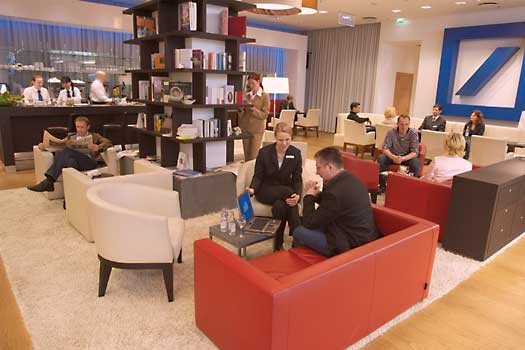
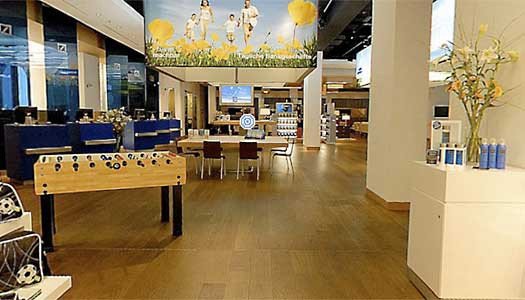
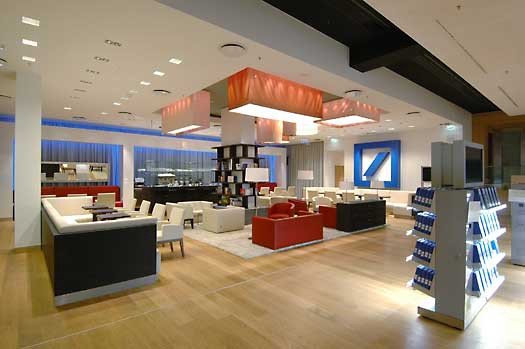
Is this really a bank? Or a cafe? Or a lounge? Is this the right place? Where are the counters? The cubicles?
  • April 10 2021|
  • 0 comments |
  • Category : Perspectives

Staring at a wide-open space that leaves you scratching your head and furrowing your brow: Is this really a bank? Or a cafe? Or a lounge? Is this the right place? Where are the counters? The cubicles? It makes me glad to see the Q110- the Deutsche bank of Future retail in Berlin. It is a great example of what a bank could be in a mundane and often boring banking world. Here the customers are called guests and are greeted with a very friendly atmosphere and ushered into comfortable meeting rooms built in the bank branches.

Their planning began with a totally new approach to what a bank should be and how the physical and virtual experience should be, to their services, touchpoints, and interactions. Their approach strongly reflects a vision that is based on service design principles, where the bank branch is not designed in the typical way of optimising space at the cost of customer experience and services that are not planned only to achieve sales.

Bankers and Leaders need to understand that the banking process is part of a service, from the moment the customer thinks of a bank or a financial product, or walks in or logs into a bank portal or app, or using a payment gateway, or using helplines or bots, and until he leaves the bank or logs out and later opts again to use the service. Service design focuses on the overall experience and the design of the service delivery processes and strategy. It focuses on crucial points of contact with customers such as initial interaction whether virtual or physical, engagement phase, and post-consumption experiences. While planning a banking service experience, one also needs to find a balance between user needs, the business vision, underlying processes, technology intervention possibilities, and market scenarios.

According to a recent survey by PWC, there are 3 main trends in the state of the banking sector in 2020:

  1. Develop a customer-centric perspective and create a frictionless user journey
  2. Real-time intelligent data integration through artificial intelligence and cognitive computing
  3. Open banking solutions

One of the tools used in the planning of the service is the service blueprint. This is a macro planning tool that allows the service designer to see beyond the product or service and to have a clear picture of the entire system that brings the customer experience to life.

Compared to customer journey mapping, which primarily examines customers’ overall journey in using a banking product or a service, service planning maps the behind-the-scenes interlinks between processes, tools, technology, and people, and thus provides a 360-degree overview of the entire service.

Trust, empathy, and commitment are additional aspects that a modern customer seeks when choosing their financial service provider. This means banks need to develop banking processes that allow customers to be open, honest, and encourage them to voice their problems freely, build trust with their clients. The purpose of the service plan is to explore how the structures supporting customer journey work, what are the responsibilities, and what are the rules that determine what can and cannot be implemented.

(This Perspective was originally published on April 9, 2021 by Shekhar Badve on LinkedIn)

‹ Prev12345Next ›Last »
© 2018 Lokus Design Pvt. Ltd. All Rights Reserved.